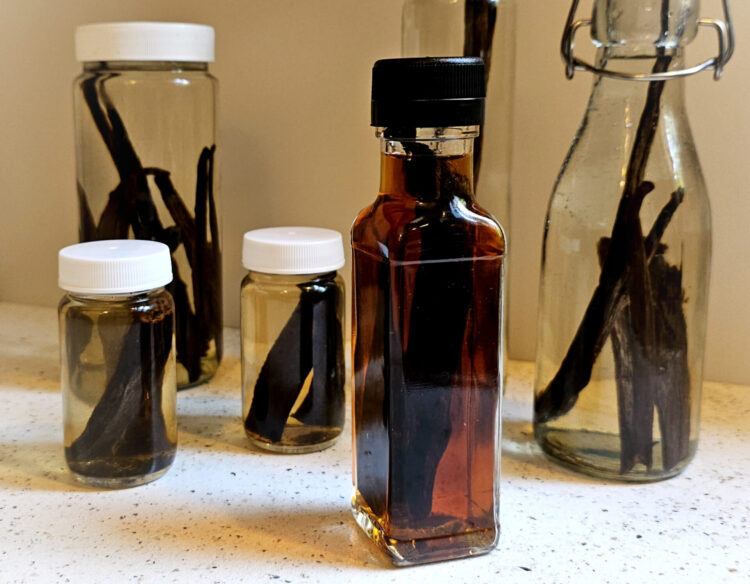
In this blog post, we’ll talk about How to Make Homemade Pure Vanilla Extract in 5 Easy Minutes, the origins of vanilla and the qualities of the three primary types. I’ll also share with you my source for Mexican vanilla beans.
If you’re an avid baker or simply someone who loves the rich, aromatic flavor of vanilla, you’ll be delighted to learn how easy, cost-effective and rewarding it is to create your very own homemade pure vanilla extract. Not only will you have the satisfaction of crafting a pantry essential from scratch, but you’ll also enjoy the superior taste and quality that comes with it. Forget the store-bought options filled with additives; this step-by-step guide will show you how to make a superb homemade vanilla extract in just five easy minutes. Get ready to elevate your culinary creations with this pure and natural essence that will add depth and warmth to your favorite recipes.
Jump to RecipeTable of Contents
The past, present and future of vanilla
I could picture my father smiling as I sat writing this post about How to Make Homemade Pure Vanilla Extract. He was very proud of his Mexican heritage and never missed an opportunity to shine a spotlight on every culinary dish, celebrity actor, musician, artist or politico of Hispanic origin. He grew up in a time when there were fewer opportunities and a good number of barriers. He took pride in seeing Latinos succeed. And of course, everything good came from Mexico.

So as this blog post unfolds, and I write about the origins of vanilla and my favorite professed, I am sure he is pleased to hear me declare that vanilla originated in Mexico and that Mexican vanilla is the best – the standard by which all other vanillas should be measured. There! I not only said it, but I believe it wholeheartedly!
Personal preference aside, my statement on the origin of vanilla is actually true. Vanilla beans originated from the tropical orchid species Vanilla planifolia. These orchids are native to Mexico and were originally pollinated by native species of bees. Today, most vanilla orchids are cultivated in various regions around the world with suitable climates and often lovingly pollinated by hand.
While Mexico remains a significant producer, other countries like Madagascar, Tahiti, and Indonesia have become major vanilla-producing regions. Madagascar is the largest producer and known for its rich and creamy vanilla. Tahiti is second and produces vanilla that is known for its unique floral notes, and then there’s Mexican vanilla. Although each of these countries are renowned for their distinct vanilla flavor profiles and are major contributors to the global vanilla market, I still stand by my statement that Mexican vanilla is the best. I just prefer the taste.
Mexican vanilla’s unique flavor profile
I’ve heard people describe Mexican vanilla as smokey. That hasn’t been my experience. This reputation for being smokey is one reason why I think people who aren’t familiar with real Mexican vanilla may be hesitant to give it a fair try. Instead, I would describe it has having subtle, warm spice notes – similar to cinnamon – that come through and add a depth of flavor that I have not been able to find in other types of vanilla. I’ve experimented with others, but I always come back to Mexican vanilla as my standard.
I recently made a batch of cookies – a recipe I have made for years – and yet it came out tasting different. Not bad, just very different. Had someone been eating the cookies for the first time, they would have thought nothing of it, but even my husband commented that they tasted good, but different. Since it pierced his veil of consciousness without any prompting from me, I knew I wasn’t just overthinking the flavor of the cookies.
After considerable tasting and thinking and tasting again, it finally dawned on me that the only thing that had changed was that I had used a different type of vanilla. I had run out of my standard Mexican vanilla and was using another brand that I had picked up at the local grocery store in a flurry. I looked at the bottle and there was my answer, “Synthetic Vanillin.” Yep. I had used fake vanilla flavor. Yeah, I gasped in disbelief, too when I read the label.
Vanillin isn’t necessarily a bad thing
So, what is Vanillin exactly? Vanillin is a compound that contributes to the characteristic vanilla flavor and aroma that we have all come to know and love. It can occur both naturally and synthetically. There’s some confusion about whether it’s an acceptable ingredient in vanilla extract. From my perspective, if it’s the naturally occurring variety, it’s a good thing.
- Natural Vanillin: Natural Vanillin is found in the vanilla bean, specifically in the seeds and wall of the pods. It’s the primary compound responsible for that classic vanilla flavor we all know and love. When you scrape the tiny black seeds from a vanilla bean, you’re extracting natural Vanillin. This is the most sought-after form of Vanillin for culinary and fragrance purposes.
- Synthetic Vanillin: The majority of Vanillin used commercially is synthesized from various sources, including wood pulp, coal tar, and clove oil. Synthetic Vanillin is not derived directly from vanilla beans, and although it replicates the flavor and aroma of natural vanilla, the discerning palate will notice the difference.
In recent years, there has been a growing preference for natural Vanillin due to consumer demand for more natural and authentic flavors. Even though natural Vanillin is present in the vanilla bean pod itself, it’s expensive. Because of the cost to produce, process and source natural vanilla, synthetic Vanillin remains widely used in the food and fragrance industries today.
Voladores: a vanilla supplier on a mission

I want the real deal when it comes to vanilla, and especially Mexican vanilla, and I like to support local and US-based companies as much as possible, but where do you turn for a product such as vanilla that is produced halfway around the globe? You go to Pennsylvania, or perhaps more accurately, you go online and order from Voladores Vanilla, located in Bethel Park, PA. I encourage you to visit their website to learn more about the company, its history and thoughtful approach to preserving Mexico’s vanilla heritage for yourself. It’s a sweet, inspiring story.
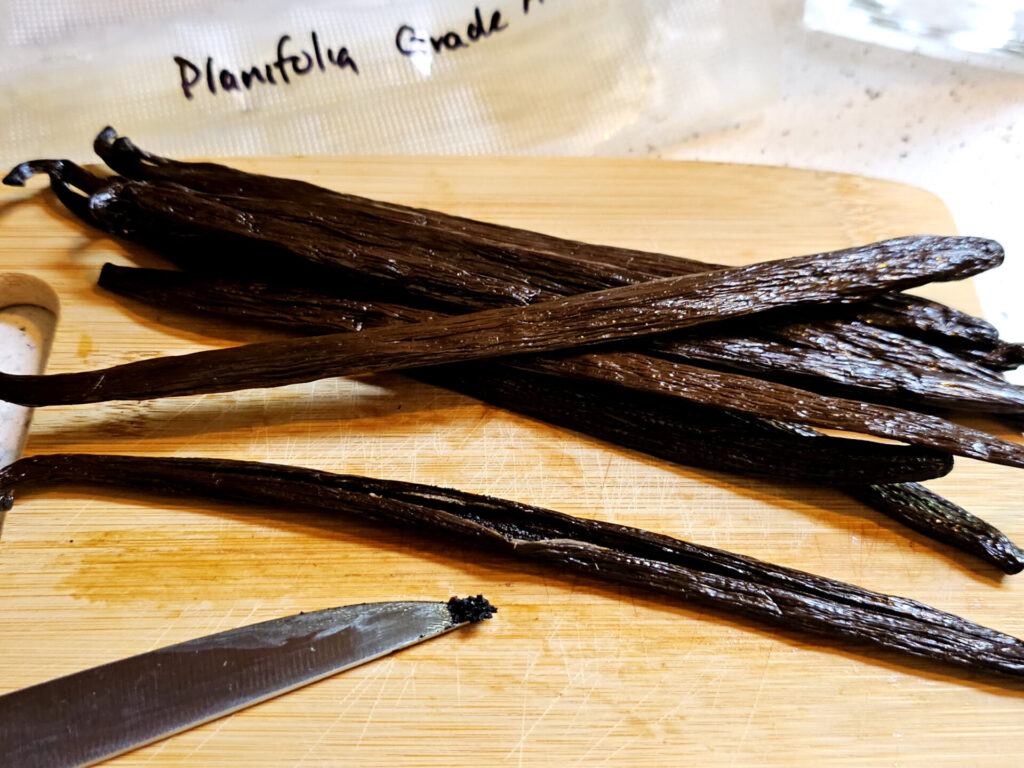
I stumbled across Voladores Vanilla recently when I was looking for a supplier of real Mexican vanilla. Their vanilla beans looked amazing on screen and they were even more plump and fragrant when my order arrived a few days later – not like the shriveled, dried out beans we’ve all seen packaged in what looks like test tube vials. I purchased one of the Grade A Planifolia Beans and one of the Grade A Mexican Pompona Beans. They were so gorgeous that I almost didn’t want to cut into them to make pure vanilla extract. Almost. I’m so glad I did, because the caviar – the vanilla bean seeds inside the pod – were more deliciously fragrant that I ever could have imagined.
I also love the story behind this company. Not only do the owners have roots in Mexico, their mission is to work directly and fairly with small vanilla growers in Veracruz, Mexico. They have built a relationship with the farmers who are working to both support their families through their trade, and preserving a time-honored Mexican tradition in the process. And they are doing it all without compromising on the quality of the vanilla they sell.
How to Make Homemade Pure Vanilla Extract in 5 Easy Minutes
Making your own vanilla may seem like it should be more involved than what I’m about to describe, but with only two ingredients it really is a simple process. You’ll need to:

- Measure 3-5 beans per 1 cup of unflavored vodka. If using Voladores Grade A beans, 2-3 beans per cup of alcohol will be sufficient.
- Gather and clean your glass bottles.
- Make a small slit lengthwise in the vanilla beans before adding them to the bottle.
- Fill the bottle with 80 proof vodka (40% alcohol by volume).
- Cover, shake and wait a minimum of 2 months to allow the flavor to permeate the alcohol. If you can wait 6 months, the flavor will be even better.
- Store your vanilla in a cool, dark place in your pantry. Shale it every week to help the time pass more quickly.
And that is truly all there is to it. I have seen references to using brandy or rum as the alcohol of choice for making vanilla extract, but I prefer the clean flavor of vodka – especially when using such lovely Mexican vanilla beans as these.
After two months, you’re ready to begin using your vanilla in all your favorite baking recipes. However, if you have the patience to wait a little longer, the flavor becomes even richer, deeper at 6 months.
If you’re looking for a recipe that really allows the flavor of the Mexican vanilla to shine through, give this recipe for Mexican Polvorones cookies a try. I promise they won’t disappoint. Enjoy and have fun making your own vanilla extract.

Homemade Pure Vanilla Extract in 5 Easy Minutes
Course: Pantry StaplesCuisine: Mexican AmericanDifficulty: Easy1
cup5
minutesMexican vanilla beans are steeped in vodka to make the most delicious and aromatic homemade vanilla extract.
Ingredients
1 cup of 80-proof unflavored vodka (40% alcohol by volume).
2-3 Grade A Mexican Vanilla beans. You’ll need 3-5 vanilla beans if using another variety.
Cleaned and dried glass bottles.
Directions
- Wash, dry and have ready your glass bottles for filling. Bring a large pot of water to the boil. Reduce the heat to a simmer and carefully emerge your bottles and tops in the hot water bath for 2 minutes. Carefully remove the bottles and tops with a set of tongs and lay out on a clean towel to dry and cool.
- While the bottles are cooling, use a small paring knife to cut a slit lengthwise in the vanilla beans. This allows the vanilla and alcohol to infuse more easily.
- Place vanilla beans in the bottles.
- Fill the bottles with vodka. Close the tops and give the bottles a gentle shake. Repeat as many times as desired.
- Allow vanilla extract to rest for a minimum of 2 months, but longer is better. Store is a cool, dark place and give your bottles a shake once a week to encourage the infusion of flavor. Enjoy in your favorite recipes.
Notes
- Alternate measurements for different sized bottles. For gift-size, smaller bottles, I used one of the plumper Pompona beans with 2 ounces of vodka. I used six of the Planifolia beans for a larger 2-cup bottle. To encourage better flavor saturation, I ran a slit down the center of all the beans with a paring knife.